What we shared at IIEX North America about delivery platforms and consumer choice
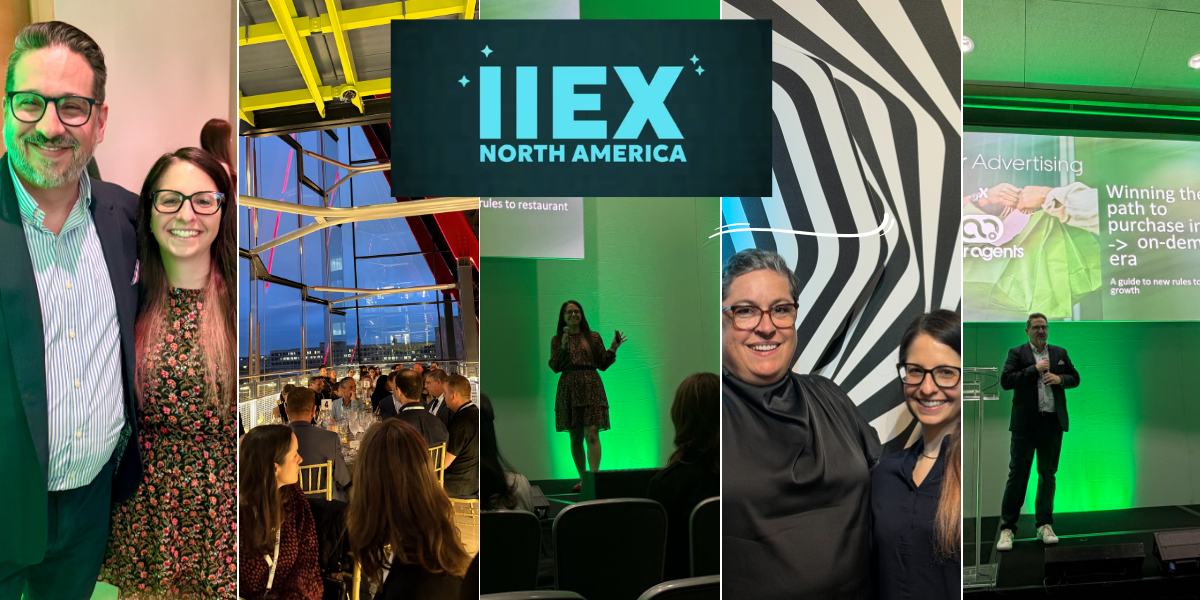
At this year’s IIEX North America 2026, our Chief Research Officer Heather O’Shea joined Uber’s David Iudica on stage to unpack how restaurant decisions are changing in a world shaped by delivery platforms, compressed decision timelines and endless consumer choice.
The session, “The $100B Delivery Funnel: How Uber Eats Shapes Choice,” explored findings from a multimodal research study conducted by Alter Agents and Uber Eats. The work combined large-scale quantitative research with mobile ethnographies to better understand how consumers move between delivery, takeout and dine-in decisions and what actually influences those moments in real time.
The topic resonated throughout the conference. Across industries, brands are trying to understand how consumer expectations around speed, convenience and personalization are reshaping the path to purchase. In restaurants specifically, the pace of decision-making has accelerated dramatically.
“As consumers, we’re seeing the velocity continue to increase every single year of how quickly consumers are going and making these purchase decisions,” David said during the session. “Apps like Uber Eats are responsible for a significant amount of that shift.”
Understanding the “why” behind restaurant decisions
Uber brought a rich set of first-party behavioral data into the engagement, but the team wanted to better understand the motivations behind how consumers were navigating restaurant choices across delivery, takeout and dine-in occasions, so they engaged Alter Agents.
Heather explained that the research approach focused on combining scale with behavioral nuance. The quantitative portion of the study surveyed 4,000 recent restaurant purchasers across dine-in, takeout and delivery occasions. The team then layered in mobile ethnographies with participants across the U.S., asking them to record and screen share their ordering journeys in real time.
Rather than relying on stated intent, the methodology focused on people who had recently completed restaurant purchases and worked backward through the actual decision process.
“There’s always very often a disconnect between what people say they’ll do and what they do,” Heather said. “So instead, we focus on people that just did the thing that we wanted them to do in that category and have them work backwards from there.”
The mobile ethnography component surfaced especially revealing moments. In one example shared during the session, a participant opened Uber Eats intending to order Five Guys but ultimately selected Chili’s after browsing options inside the app. That type of real-world behavioral capture helped visualize how quickly consideration sets can shift inside delivery environments.
The rise of the “now generation”
One of the themes from the research centered on what the presenters described as the “now generation,” largely made up of Gen Z and millennials who blend immediacy with intentionality in their restaurant decisions. The findings showed that three in four restaurant consumers make purchase decisions in under an hour, with delivery decisions happening even faster. Convenience, speed and customization increasingly shape what brands make it into consideration sets at all.
Heather noted that many consumers are not entering apps with a specific restaurant already selected. Instead, they arrive with a need state.
“They’re saying, ‘I’m hungry now. Feed me,’” she said.
That shift changes how restaurant brands need to think about visibility, merchandising and platform presence. Consumers are consulting more information sources than ever, even as decision timelines shrink.
The presentation also explored how delivery platforms increasingly function as modern digital food courts, allowing consumers to compare restaurants, promotions, reviews and delivery times in one place. According to the research, platform visibility is beginning to rival the importance of restaurant menus themselves in influencing decisions.
Curious loyalty and the changing nature of restaurant choice
Another major theme from the session was what Uber described as “curious loyalty.”
Consumers still demonstrate strong repeat behaviors, but they are also increasingly open to experimentation when presented with convenient alternatives inside delivery apps. The study found that while many Uber Eats users repeatedly order from favorite restaurants, the same consumers also regularly try new options. The result is a purchasing environment where loyalty and exploration coexist simultaneously.
David explained that the research challenged the idea that loyalty and discovery are mutually exclusive behaviors. “As a customer, you can be both loyal and you can also be curious,” he said. “Platforms like Uber Eats actually help facilitate both of those activities.”
That creates both opportunity and pressure for restaurant brands competing in crowded digital environments.
For marketers and insights teams, the implications extend well beyond food delivery. The session highlighted how multimodal methodologies can help brands capture both scale and emotional nuance in categories where decision-making is happening quickly, emotionally and across multiple touchpoints.
Connecting with the industry at IIEX
Beyond the session itself, IIEX provided an opportunity for the Alter Agents team to reconnect with colleagues, clients, partners and longtime industry friends.
O’Shea attended the conference alongside Alter Agents CEO Rebecca Brooks, with conversations throughout the event centering on how consumer expectations, technology and behavioral research methods continue to evolve together.
One highlight of the week was joining partners and friends from TestSet for dinner at the International Spy Museum, a fitting backdrop for conversations about human behavior, decision-making and the future of insights.
Thought Leadership Updates
Get updates in your email.