The “trust recession”: How shoppers navigate uncertainty
Over the past six years, consumers have lived through a steady stream of disruption. A pandemic reshaped routines and priorities. Inflation raised the cost of everyday life. Political polarization and social unrest deepened anxiety. AI accelerated questions around trust, information and authenticity. At the same time, shopping itself became more fragmented, more digital and more cognitively demanding.
At Alter Agents, we have been tracking those shifts since 2019 through an ongoing consumer sentiment study designed to understand how Americans are navigating uncertainty and how those pressures are changing behavior.
What began as a study about consumer anxiety has evolved into something broader: a long-term view into how trust, economic pressure, AI-driven uncertainty and information overload are reshaping the relationship between consumers and brands.
The latest wave of the research found consumers entering what Alter Agents describes as a “trust recession,” a period where confidence in institutions, brands, information and even other people is under pressure.
This is changing not only what people buy, but how they make decisions, who they trust and what they expect from brands.
Everything, everywhere, all at once
This new wave of our research positions today’s environment as a modern “polycrisis”, a convergence of economic uncertainty, geopolitical instability, social fragmentation and rapid technological change happening simultaneously.
Consumers are navigating:
- Rising prices and persistent inflation
- Global conflict and political instability
- Growing distrust in institutions
- AI-driven uncertainty around information and authenticity
- A constantly expanding digital decision environment
The result is a consumer mindset defined by caution, skepticism and self-preservation. The current environment is not being driven by one singular crisis. Consumers are experiencing economic strain, information overload and declining trust all at once, fundamentally changing how they shop and make decisions.
Consumers are pulling back
The economic pressure consumers are experiencing is shaping day-to-day behavior. We found a significant slowdown in consumers willing to increase spending heading into 2026, even among households that still consider themselves financially stable. While many consumers said they planned to spend about the same as the previous year, far fewer said they expected to spend more.
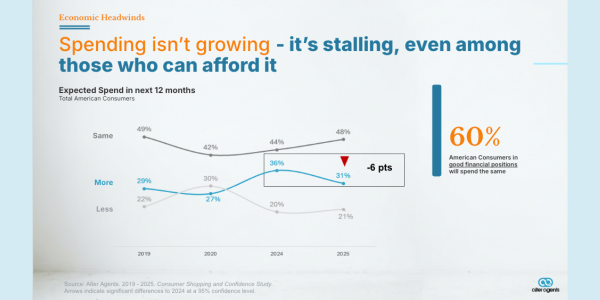
That shift matters because higher-income consumers have helped sustain discretionary spending across categories for years. As even those consumers become more cautious, the effects spread more broadly across retail and consumer markets.
At the same time, optimism about the future continues to erode.
Earlier waves of our tracking research found 81% of Americans believed their future would improve over time. That number has now fallen sharply, reflecting growing pessimism across economic, social and technological dimensions.
The emotional relationship consumers have with shopping is changing as well:
- Consumers say shopping feels stressful rather than enjoyable
- Major purchases feel riskier and require more deliberation
- Consumers are looking forward to shopping less than they did in previous years
- Many households are postponing major life decisions including home purchases and starting families
The behavioral changes are becoming visible across categories.
Alter Agents found:
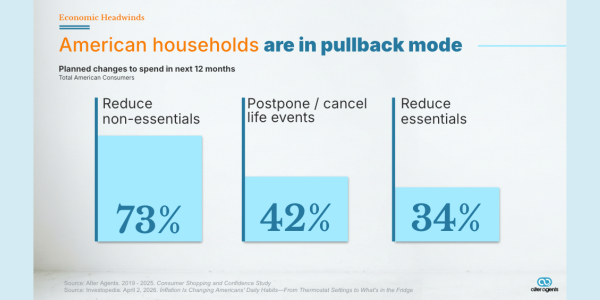
- 73% of consumers are reducing nonessential spending
- 42% are postponing or canceling major life events
- 34% are reducing spending even on essentials
The findings point to households entering what the research describes as “pullback mode,” where nearly every purchase feels more consequential.
Consumers are also adapting in ways that reflect a broader reset around value.
The study found 1 in 3 consumers are deliberately making shopping trade-offs such as switching to lower-priced brands or buying private label products.
Consumers are adapting in several ways:
- Secondhand and resale marketplaces continue growing in popularity across apparel and lifestyle categories
- Households are becoming more analytical about everyday purchases, from groceries to utilities
- Consumers are comparing prices more frequently and delaying replacement purchases
Katie Zmijewski, research director at Alter Agents, described the environment as a “survivalist shift” where consumers focus heavily on immediate needs while retreating from future-oriented spending.
Historically, consumers often emerged from periods of economic disruption with lingering value-oriented behaviors that persisted long after the immediate crisis ended. Alter Agents believes similar long-term effects may already be taking shape.
The era of “peak optimization”
Consumers can purchase almost anything instantly. Recommendations follow them across platforms, delivery windows continue shrinking and shopping has become deeply integrated into everyday mobile behavior.
In theory, shopping should feel easier than ever. Instead, many consumers feel overwhelmed.
At Alter Agents, we describe the current environment as “peak optimization,” or the point where constant optimization begins creating friction instead of reducing it.
The modern shopping experience was designed for speed and efficiency, but many consumers now describe it as cognitively draining. Endless choice, constant connectivity and an always-on digital environment have made even simple purchase decisions feel heavier and more demanding than they did just a few years ago.
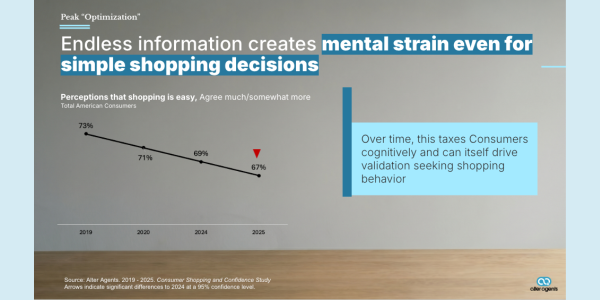
Consumers now move through infinite-scroll retail environments, nonstop recommendations, algorithmic personalization and fragmented information ecosystems that never fully turn off. As Rebekah Bell, associate research director at Alter Agents, explained during our recent webinar, shopping no longer has clear beginnings and endings. Consumers browse while waiting in line, scrolling social media, watching streaming content or filling small moments throughout the day.
At the same time, counterfeit products, fake storefronts and manipulated reviews are adding another layer of skepticism, fundamentally reshaping how consumers approach purchase decisions.
Trust is becoming harder to earn
One of the strongest themes emerging from the research is the erosion of trust across the shopper journey. Consumers no longer take information at face value. Reviews, recommendations and even retailer legitimacy are viewed with greater skepticism than they were just a few years ago.
Consumers are approaching reviews with far more skepticism than they once did. Rather than relying on simple star ratings, shoppers are digging deeper into written experiences, photos, videos and negative feedback as they try to determine what feels authentic online.
Consumers are not only evaluating products, but also questioning whether the surrounding information ecosystem itself is credible. That skepticism extends directly into how brands are perceived.
Alter Agents found:
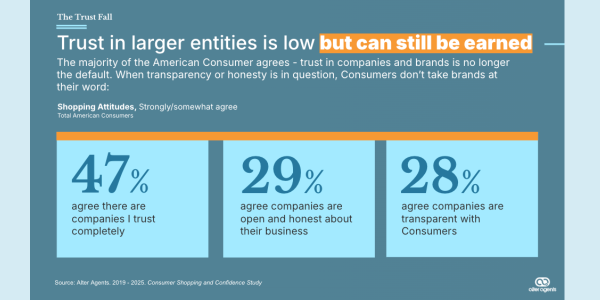
- Only 29% of consumers believe companies are open and honest about their business practices
- Only 28% believe companies are transparent with consumers
- At the same time, 47% say they can still identify companies they trust completely, suggesting trust is still attainable but must be earned more actively
The research also points to a major shift in how consumers establish trust.
Rather than relying solely on institutions or broad brand messaging, consumers are placing greater weight on more relatable sources of validation. Creator reviews, peer recommendations, online communities and real-world experiences often feel more credible and authentic than traditional advertising or celebrity endorsements.
Consumers are narrowing their “circle of trust,” relying more heavily on peer validation, creators, niche communities and distributed recommendation networks. That trend mirrors the broader institutional distrust happening across society.
Our webinar highlighted decades-long declines in trust toward government and institutions, alongside another striking figure: according to Pew Research only 34% of consumers now say they trust other people generally, down significantly from earlier decades.
AI is adding another layer of uncertainty
AI is often positioned as the answer to decision fatigue and information overload, but consumers are not fully convinced.
Research discussed during the webinar suggests AI-assisted shopping experiences can sometimes deepen consumer skepticism rather than reduce it. Recommendation engines, chatbots and AI-generated summaries may help shoppers move faster, but many still feel the need to double-check the information themselves.
Part of the tension comes from a broader discomfort around authenticity online:
- Consumers question whether AI-generated content is accurate
- Recommendation systems can create doubt instead of reassurance
- The line between human-made and machine-generated content feels less clear
- Consumers are spending more time trying to determine what is real
We can compare this moment to previous technological revolutions such as the Industrial Revolution, but with one important difference: industrialization automated physical labor, while AI touches judgment, cognition and decision-making itself.
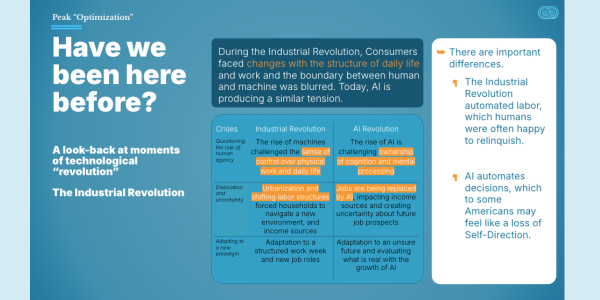
For many consumers, that creates a sense of lost control rather than convenience.
As AI tools become more common across the shopper journey, brands may need to work harder to provide transparency, human reassurance and clear signals of authenticity.
The emotional relationship with brands is weakening
Another major shift emerging from the research is the changing role of emotion in brand loyalty. For years, marketers focused heavily on emotional connection, relevance and affinity. Those elements still matter, but many consumers today are making more defensive and practical purchase decisions. Reliability is becoming more important than excitement.
Nearly 8 in 10 consumers say they regularly purchase from five brands or fewer, reinforcing how difficult it has become for brands to maintain lasting loyalty in a fragmented environment.
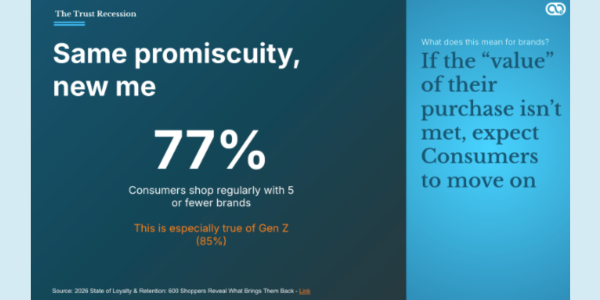
At the same time, fewer than 1 in 4 consumers say emotional connection is what drives repeat purchases.
Instead, consumers are increasingly repurchasing products because:
- They know the product works
- They want to reduce risk
- They lack the time or energy to research alternatives
- Familiarity feels safer than experimentation
This creates a more fragile relationship between brands and consumers. Consumers may continue buying familiar brands because those products reduce uncertainty, but they remain willing to switch when another option feels more reliable, transparent or worth the cost.
The findings reinforce a trend Alter Agents has tracked for years: shopper promiscuity.
Consumers have more options than ever before and lower switching barriers across nearly every category. Digital commerce continuously exposes shoppers to alternative brands, substitute products and new entrants.
In this environment, earning a place in a consumer’s trusted “short list” becomes significantly harder.
The return of human connection
One of the most interesting tensions emerging from the research is that consumers still value convenience and digital tools, but they are also beginning to crave more human experiences.
In many cases, the pendulum may have swung too far toward automation.
Consumers want:
- Access to real customer support
- Human reassurance during problems or disruptions
- More tactile and in-person shopping experiences
- Greater transparency from brands
- Experiences that feel less transactional
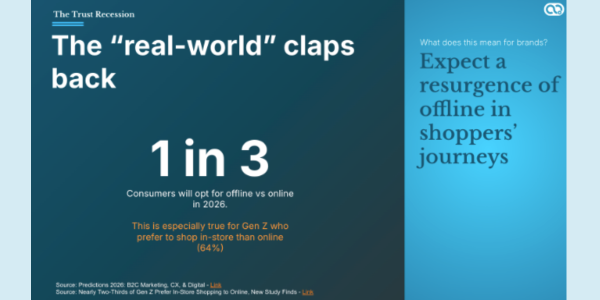
This is especially visible among younger consumers. While Gen Z is deeply digital, many younger shoppers are also showing renewed interest in physical retail experiences, experiential shopping and human-centered interactions.
The brands that succeed over the next several years may be the ones that combine efficiency with reassurance, convenience with transparency and personalization with human support.
Opportunity in the chaos
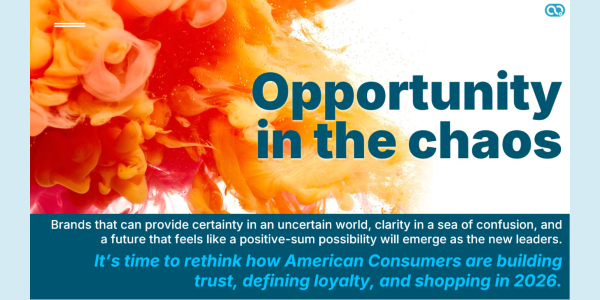
While the research paints a picture of caution and skepticism, it also highlights clear opportunities for brands. Consumers are still willing to trust companies and products, but that trust now has to be earned more intentionally.
The brands most likely to succeed during this trust recession will be the ones that provide certainty in uncertain environments, transparency in moments of confusion and reassurance alongside convenience.
Several shifts may shape the next phase of consumer behavior.
Consumers are expected to spend more time evaluating purchases before committing, extending an already complicated “messy middle” as shoppers move across multiple channels to validate decisions. Physical retail and human interaction may also regain importance as consumers seek tactile experiences, reassurance and support that feel more credible than fully automated systems.
Our findings also point to a more pragmatic form of consumer behavior. Reliability, consistency, quality and convenience are becoming more important than emotional aspiration or brand storytelling alone. Loyalty is becoming harder to earn as consumers narrow the number of brands they buy regularly while remaining highly willing to switch when trust breaks down.
For brands, this creates a different challenge than the past decade of digital optimization. The goal is no longer simply reducing friction or accelerating conversion. It is helping consumers feel confident, informed and supported in a marketplace where certainty feels increasingly scarce.
Rebuilding trust becomes the next competitive advantage
The past several years reshaped how consumers think about money, information, technology and decision-making. What emerges from this research goes beyond economic anxiety or digital fatigue, and instead reflects a broader recalibration around trust.
Consumers are becoming more cautious, skeptical and deliberate across nearly every aspect of the shopper journey. They are evaluating products more carefully, questioning information more frequently and relying more heavily on peer validation before making decisions.
For brands, that means the future may belong to those that help consumers feel confident, supported and informed. In a trust recession, reassurance, transparency and confidence become far more valuable to consumers than speed alone.
Thought Leadership Updates
Get updates in your email.